
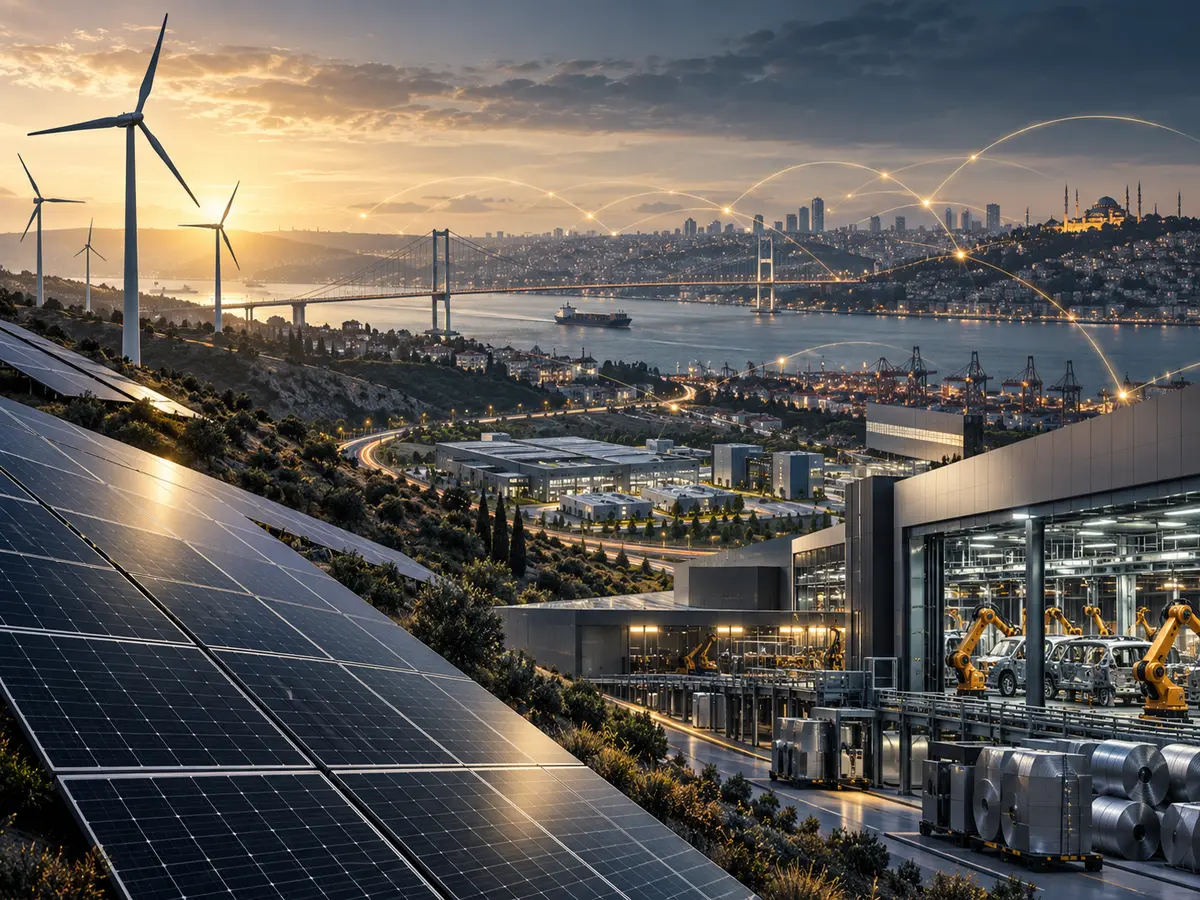
Türkiye’s strongest proposition for international investors may not be a standalone domestic investment. It may be the opportunity to build a regional platform that combines Turkish industrial capability, engineering talent and export infrastructure with GCC capital, market access and long-term strategic ambition.
Why the opportunity is becoming more relevant
Türkiye’s Foreign Direct Investment Strategy targets a 1.5% share of global FDI by 2028 and places greater emphasis on high-quality, development-oriented investments. The investment framework includes project-based support, R&D incentives, customs and VAT exemptions, financing support and other instruments that can materially shape the economics of a qualifying project.
Three sectors to watch
1. Clean energy, storage and grid modernisation
Türkiye’s installed electricity capacity reached nearly 120 GW in 2025. The country is targeting 120 GW of combined wind and solar capacity by 2035, while approximately 33 GW of battery-integrated wind and solar projects are in the pre-licensing pipeline. Regular auctions, dollar-based feed-in tariff mechanisms and the need to modernise transmission and distribution infrastructure create opportunities beyond conventional generation.
Potential models include renewable and storage joint ventures, industrial self-consumption platforms, energy-as-a-service, grid software, energy management systems and local production of equipment and components.
2. Advanced manufacturing and mobility
Türkiye produced approximately 1.42 million vehicles in 2025, ranking fifth in Europe and thirteenth globally. Around 75% of vehicle production was exported, and 169 automotive R&D and design centres were operational as of 2026. This creates an opportunity set that extends beyond vehicle brands into battery systems, power electronics, commercial vehicles, automation, components and engineering services.
The HIT-30 programme identifies mobility, green energy, advanced manufacturing, digital technologies and semiconductors as priority areas, with up to USD 30 billion in support planned for high-technology investments by 2030.
3. ICT, AI and regional digital infrastructure
Türkiye’s ICT market reached an estimated USD 36.7 billion in 2024. More than 11,700 active companies and over 246,000 employees operate in the sector, while ICT exports reached approximately USD 3.3 billion across Europe, MENA, Asia and North America.
The most compelling opportunities may be focused B2B platforms embedded in manufacturing, logistics, energy, finance or public services: industrial analytics, cybersecurity, cloud services, supply-chain technology and AI-enabled operating models.
The central question is not simply, “Which Turkish sector should we enter?” It is: Which Turkish capability can be combined with GCC capital and market access to create a scalable regional business?
What investors should test first
- Does the local partner provide a real capability, not only market access?
- Can the business generate export revenue or other hard-currency resilience?
- Is the regulatory, incentive and permitting path understood?
- Can the model be replicated across Türkiye, Europe and MENA?
- Are governance, execution responsibility and downside protection clearly defined?
For GCC-based strategic investors, the strongest entry model may therefore be a partnership rather than a passive allocation: combining capital with technology transfer, procurement power, distribution, project development or regional commercialisation.
Ainos Ventures can support this process by connecting strategy, financial assessment, partner evaluation, capital structuring and execution. The objective is to move from market interest to investable partnerships, joint ventures and operating platforms.